Trump fires messenger, blows away credibility
(Originally published Aug. 4 in “What in the World“) Trump shot the messenger, making it painfully clear he doesn’t get the message.
On Friday, he got to use his trademark line, firing Bureau of Labor Statistics Commissioner Erika McEntarfer after the bureau published data showing weak hiring in July and revised downward its estimates of job growth for the previous two months. Trump accused Biden-appointed McEntarfer of rigging the data. “So you know what I did?” Trump told reporters. “I fired her, and you know what? I did the right thing.”
Let’s start with the hue and cry over firing one of the economy’s chief statisticians. Even if Trump’s right and McEntarfer was overseeing some liberal conspiracy to embarrass him by skewing data, firing her in a pique after publishing a jobs report looks like retaliation, and investors will now need to wonder if any future jobs data has been nudged upward as a form of self-preservation. It will thus erode confidence in U.S. economic health, and by extension in the dollar and U.S. creditworthiness, the two things that stand at the core of more intangible financial notions like “American exceptionalism” and America’s “exorbitant privilege.”
Manipulating your own economic data is something more common to authoritarian governments in developing economies like China’s, where the government has long been pressuring economists who publish negative reports, tailoring its economic data to fit its policy goals, and, when it can’t massage the data, simply withholding it from publication. We have a term for those kinds of economies. “This is the kind of thing you would only expect to see in a banana republic,” former Treasury Secretary and Federal Reserve Chair Janet Yellen said in response to Trump’s move.
What’s ironic is that the weak jobs data is likely to convince another group of bureaucrats to yield to Trump’s whims. The Federal Reserve has stubbornly refused to give in to his threats to fire Fed Chair Jerome Powell if it doesn’t cut the benchmark interest rate. Friday’s weak jobs data bolsters the case for a rate cut in September, as the economy finally succumbs to the impact of Trump’s chaotic tariffs, and narrower profit margins. But rising consumer prices only heighten the Fed’s policy dilemma under Trump: how to satisfy its dual mandate of stabilizing prices while maximizing employment.
So, what were the jobs numbers that so enraged Trump? The labor bureau said that the number of non-farm jobs rose in July by 73,000, much lower than economists expected, after rising just 14,000 in June, the smallest increase in almost five years. The U.S. unemployment rate rose the same month to 4.2% as household employment declined.
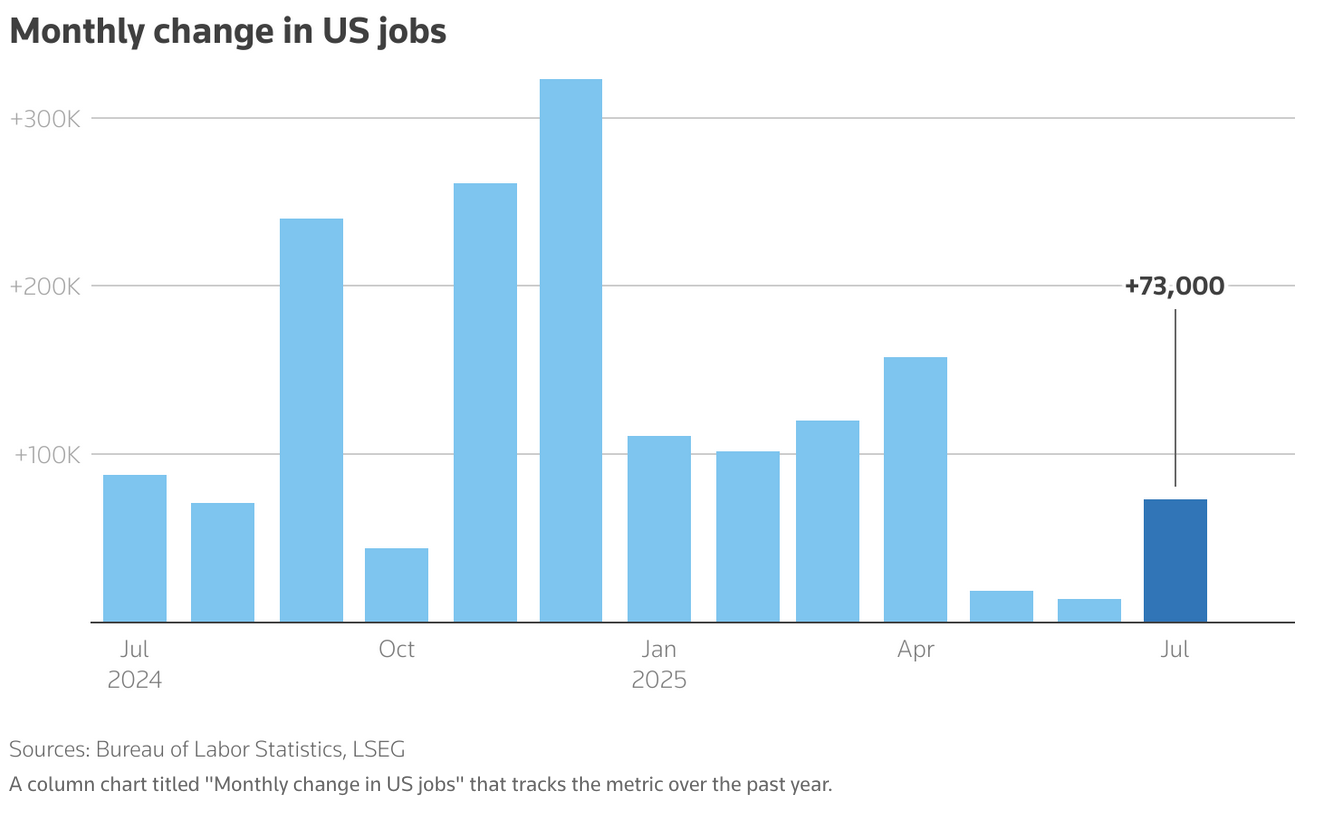
Source: Reuters
Worse, the number of people without a job for at least 27 weeks rose to 1.8 million. Excluding the surge in unemployment during the pandemic, that’s the highest level since 2017. People are also staying jobless longer: the median length of unemployment rose in July to 10.2 weeks, up from 9.5 weeks a year ago.
Source: The Wall Street Journal
And while pay for those who still have jobs is still rising, the gap between the rich and poor is widening. According to the latest data from the Federal Reserve Bank of Atlanta annual wage growth for the lowest-earning quarter of workers slowed to an 3.7% in June, down from a peak of 7.5% in late 2022. Wages for the highest-earning quarter of workers is still rising at 4.7%, and by 4.3% for the workforce overall.
But as long as Trump is running the country, reason is in retrograde. Last week, the head of the Environmental Protection Agency, Lee Zeldin, proposed repealing the finding that serves as the scientific rationale for protecting the environment. Zeldin wants to reverse the 2009 endangerment finding, which established that greenhouse gas emissions pose a threat to public health. Zeldin also said the agency would rescind Biden-era regulations aimed at cutting auto emissions.